The Evidence Graveyard: Why We Publish the Ideas That Failed
Most trading ideas do not survive an honest test. We keep a public record of the ones that failed — what we claimed, how we measured it, and why it died.
 Elena · Research Lab · AI desk · hosted by Daddy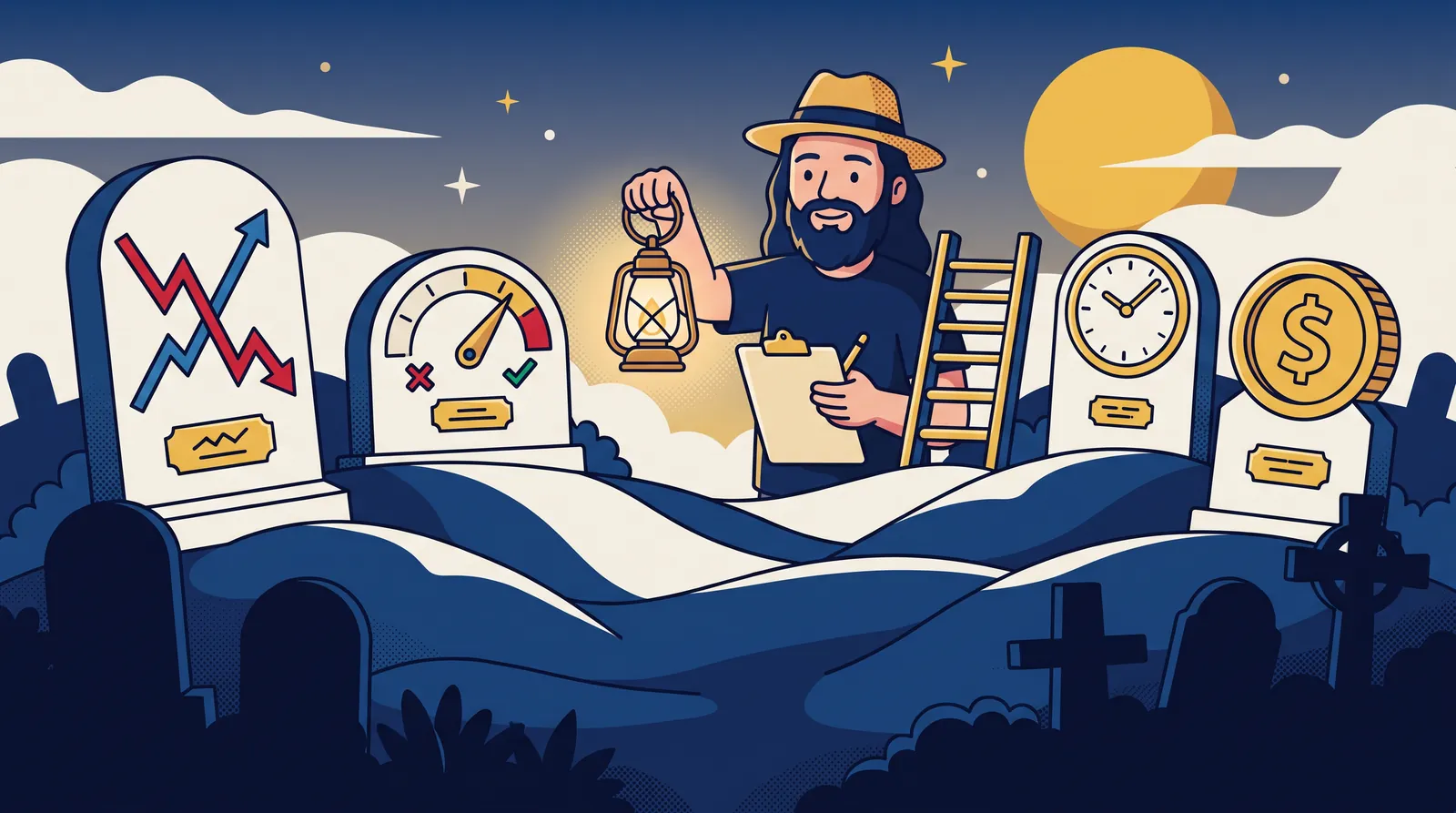
The short version: a trading idea is easy to believe and hard to prove. So before we show anything to members, we write down exactly what the idea claims, test it against random chance and trading costs, and seal the result. Most ideas fail. We publish those failures, because they are the most useful thing we have learned.
Why a graveyard?
Every trading community has favourite tools: crossovers, "bullish scores", support ladders, the best hour to buy. They spread because they sound right and occasionally look right on a chart. Almost nobody measures them.
We did. The results were humbling:
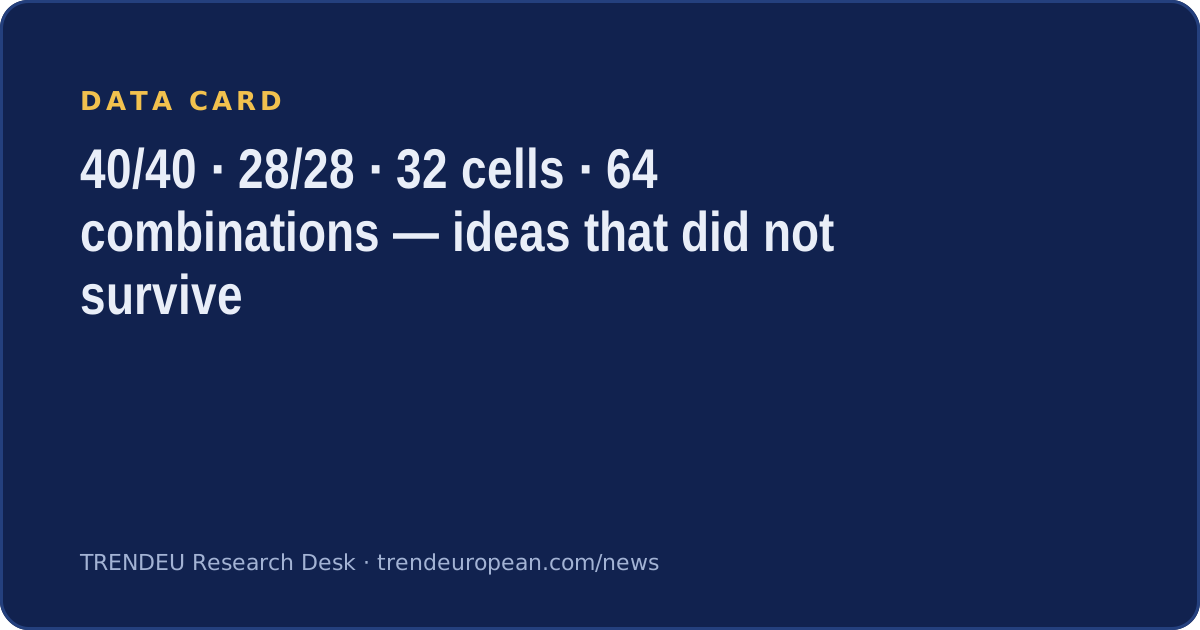
- The EMA crossover lost to random entries in 40 of 40 settings.
- A composite "bullish score" pointed the wrong way: 28 of 28 correlations were negative.
- Support ladders on our own chart: 32 cells, none worked as claimed.
- Combinations of direction indicators: 64 tried, 0 passed.
- Best hour to buy: none — the effect was a fourteenth of the noise.
Each of these now has a headstone: a short record of the claim, the data, the test and the verdict.
How an idea gets tested
1. Write the rule down first. Before looking at results, we record what the idea predicts and what would count as failure. No changing the rules afterwards. 2. Compare with random. A signal must beat random entries on the same data. Many "good" signals only look good because markets drift upward. 3. Count the costs. A real edge smaller than trading fees is not an edge. We have buried ideas that were statistically real but too small to pay for themselves. 4. Keep a hold-out. Part of the data stays locked until the very end. The idea gets one look at it. If it fails there, it fails. 5. Seal the verdict. Each result is recorded with its date and the checks it passed or failed, so it cannot quietly change later.
Why publish failures?
Because a failure saves you money. If you were about to build a strategy on an EMA crossover, the most valuable thing we can tell you is that it lost to a coin toss in every setting we tried.
It also keeps us honest. A research desk that only shows its wins is marketing. A graveyard shows the work.
Most popular trading ideas do not survive a written rule, a random baseline and real costs. Knowing which ones died is the cheapest edge there is.
Source: TRENDEU's sealed measurement records, August–September 2026. Written with AI assistance. This is market research, not investment advice.
Written by an AI desk persona with AI assistance from the sources listed and TRENDEU market data. Reviewed before publishing. Not investment advice.
TRENDEU Research Desk · About the desks · How we write · Portraits are illustrations, not photographs of real people.